





























ADVENDURE is the leading web portal in Greece about Mountain Running, Adventure, Endurance and other Mountain Sports
info@advendure.com


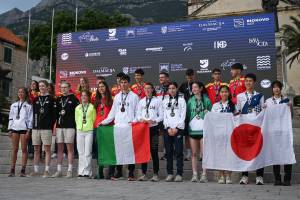
Today, the 10th edition of the Youth Skyrunning World Championships kicked off in Croatia with a lung-busting VERTICAL – a perfect VK with 980m vertical climb over 4.5 km reaching 1,264m altitude. Aged 15 to 23, these young skyrunners, including those new to the sport, showed their guts in the fight for the medals and their talent for this unique discipline.
Spain, Norway and Japan came out on top in the country ranking while Portugal took their first gold medal in the Youth Championships since they began in 2016. Close-on 200 athletes from countries as far afield as Australia, Brazil, Canada, Japan and USA participated today, making for tough competition and, as usual, great camaraderie.
Fastest time on the course today was Swiss athlete Fiorillo Camesi in 37’37” – but his gold medal didn’t come easily after battling with Spaniard Lluis Puigvert over the last 100 metres to the summit. Puigvert closed just three seconds later for the silver, his tenth medal at the Youth Championships after five editions.
Anti-doping is a fundamental aspect of sport that every skyrunner should understand. It’s easy to close an eye, but it’s also easy to be found positive, without knowing why.
In skyrunning, the stakes aren’t as high as in some trail running events or other sports, so the motivation would not be just for the financial rewards. Why would a top athlete, who is probably going to win anyway, dope? It’s extremely unlikely but on several occasions it has happened. In skyrunning, to date, these cases have always been linked to the use of therapeutic substances – but without the required exemption.
The International Skyrunning Federation is pleased to announce the addition of the VERTICAL and SKYULTRA disciplines to the 2026 Masters Skyrunning World Championships, following the recent announcement of the SKY discipline.
The VERTICAL will take place on July 3, 2026, at the same venue as the SKY, on July 4, 2026, part of the ASICS Pierra Menta Été events in Arêches, Savoie, France. The specially designed course of the new Pierra Menta Verticale will satisfy lovers of the “short and steep” with 850m vertical climb over 3.8 km delivering stretches with a 50-70% incline.
The fourth edition of the Masters Skyrunning World Championships will represent a thrilling challenge for passionate over-forties skyrunners looking for adventure. France will host the championships on July 4, 2026, at the Skyrun du Grand Mont, part of the ASICS Pierra Menta Été.
The Pierra Menta is a legendary ski-mountaineering race dating back 40 years. Ten years ago, the summer edition was launched in the same format with athletes racing in pairs. Last year, the Skyrun du Grand Mont was introduced for single athletes – an immediate success paving the way for hosting the 2026 Masters Skyrunning World Championships.
Featuring the SKY discipline, the course is 28 km long with 2,600m vertical climb reaching 2,680m altitude, starting and finishing in Arêches, Savoie.
Six years on, the VK OPEN reaches a new milestone with a rebranding and is now officially the VK OPEN World Cup. It remains the only worldwide circuit dedicated to Vertical Kilometer® races and is sanctioned by the International Skyrunning Federation.
The 2026 season features nine spectacular stages across four continents, uniting elite athletes, passionate amateurs and mountain enthusiasts under one exhilarating banner. Three new destinations expand the World Cup map across the globe — from Canada, to the USA and Japan. The calendar also travels through Europe to Portugal and Andorra, sumitting in Columbia — with the promise of a thrilling mix of landscapes, cultures and challenges for athletes and fans alike.
The journey kicks off on March 7 with the ever-faithful KM de Câmara de Lobos, hosted on the stunning island of Madeira, Portugal. Known for its spectacular coastal setting and warm local atmosphere, this race once again sets the tone for the season, combining technical difficulty with unforgettable scenery. Its short yet intense course climbs 1,000m in just 2.9 km — an ISF Technical Level 2 race guaranteeing a powerful start to the World Cup.


ADVENDURE is the leading web portal in Greece about Mountain Running, Adventure, Endurance and other Mountain Sports
info@advendure.com